Friday, May 29, 2020

From Indonesia to the United Kingdom

From Indonesia to the United Kingdom, the mosque in its many forms is the quintessential Islamic building. The mosque, masjid in Arabic, is the Muslim gathering place for prayer. Masjid simply means “place of prostration.” Though most of the five daily prayers prescribed in Islam can take place anywhere, all men are required to gather together at the mosque for the Friday noon prayer.
Mosques are also used throughout the week for prayer, study, or simply as a place for rest and reflection. The main mosque of a city, used for the Friday communal prayer, is called a jami masjid, literally meaning “Friday mosque,” but it is also sometimes called a congregational mosque in English. The style, layout, and decoration of a mosque can tell us a lot about Islam in general, but also about the period and region in which the mosque was constructed.
Diagram reconstruction of the Prophet's House, Medina, Saudi Arabia
The home of the Prophet Muhammad is considered the first mosque. His house, in Medina in modern-day Saudi Arabia, was a typical 7th-century Arabian style house, with a large courtyard surrounded by long rooms supported by columns. This style of mosque came to be known as a hypostyle mosque, meaning “many columns.” Most mosques built in Arab lands utilized this style for centuries.

Common features

The architecture of a mosque is shaped most strongly by the regional traditions of the time and place where it was built. As a result, style, layout, and decoration can vary greatly. Nevertheless, because of the common function of the mosque as a place of congregational prayer, certain architectural features appear in mosques all over the world.
Livequranforkids

We are providing the educational service of Learn quran 
online, female quran teacher,quran for kids, quran reading, 
quran memorization for kids, quran translation,online quran,  
quran for kids in USA, quran online and Online quran academy.

The Kaaba today

The Kaaba today

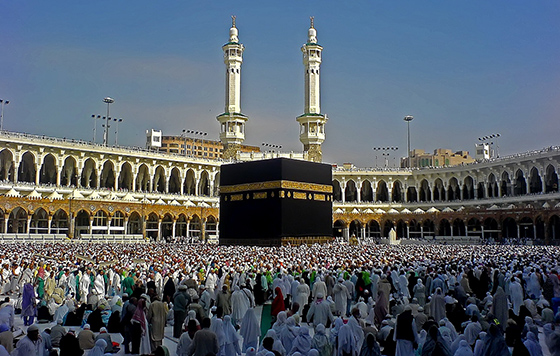
Today, the Kaaba is a cubical structure, unlike almost any other religious structure. It is fifteen meters tall and ten and a half meters on each side; its corners roughly align with the cardinal directions. The door of the Kaaba is now made of solid gold; it was added in 1982. The kiswa—the large cloth that covers the Kaaba—used to be sent from Egypt with the hajj caravan but today is made in Saudi Arabia. Until the advent of modern transportation, all pilgrims undertook the often dangerous hajj, or pilgrimage, to Mecca in a large caravan across the desert, leaving from Damascus, Cairo, and other major cities in Arabia, Yemen, or Iraq.
The numerous changes to the Kaaba and its associated mosque serve as good reminder of how often buildings, even sacred ones, are renovated and remodeled either due to damage or to the changing needs of the community.
Only Muslims may visit the holy cities of Mecca and Medina today.

Livequranforkids

We are providing the educational service of Learn quran 
online, female quran teacher,quran for kids, quran reading, 
quran memorization for kids, quran translation,online quran,  
quran for kids in USA, quran online and Online quran academy.
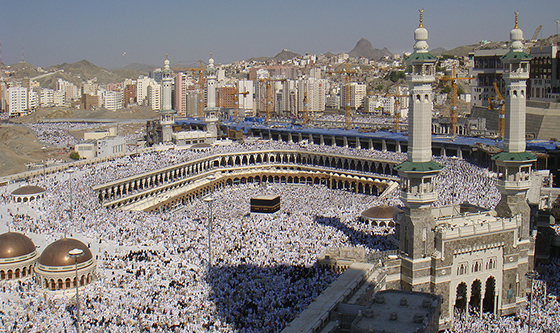
The Kaaba has been modified extensively throughout its history

Modifications

The Kaaba has been modified extensively throughout its history. The area around the Kaaba was expanded in order to accommodate the growing number of pilgrims by the second caliph, ‘Umar, who ruled 634-44 CE. The Caliph ‘Uthman, who ruled 644-56 CE, built the colonnades around the open plaza where the Kaaba stands and incorporated other important monuments into the sanctuary.
During the civil war between the caliph Abd al-Malik and Ibn Zubayr, who controlled Mecca, the Kaaba was set on fire in 683 CE. Reportedly, the Black Stone broke into three pieces and Ibn Zubayr reassembled it with silver. He rebuilt the Kaaba in wood and stone, following Ibrahim’s original dimensions and also paved the space around the Kaaba. After regaining control of Mecca, Abd al-Malik restored the part of the building that Muhammad is thought to have designed. None of these renovations can be confirmed through study of the building or archaeological evidence; these changes are only outlined in later literary sources.
Reportedly under the Umayyad caliph al-Walid, who ruled 705-15 CE, the mosque that encloses the Kaaba was decorated with mosaics like those of the Dome of the Rock and the Great Mosque of Damascus. By the seventh century, the Kaaba was covered with kiswa, a black cloth that is replaced annually during the hajj.
Under the early Abbasid Caliphs, who ruled from 750-1250 CE, the mosque around the Kaaba was expanded and modified several times. According to travel writers, such as the Ibn Jubayr who saw the Kaaba in 1183 CE, it retained the eighth century Abbasid form for several centuries. From 1269-1517 CE, the Mamluks of Egypt controlled the Hijaz, the highlands in western Arabia where Mecca is located. Sultan Qaitbay, who ruled 1468-96 CE, built a madrasa—a religious school—against one side of the mosque. Under the Ottoman sultans, Süleyman I, who ruled 1520-1566 CE, and Selim II, who ruled 1566-74 CE, the complex was heavily renovated. In 1631 CE, the Kaaba and the surrounding mosque were entirely rebuilt after floods had demolished them in the previous year. This mosque, which is what exists today, is composed of a large open space with colonnades on four sides and with seven minarets, the largest number of any mosque in the world. At the center of this large plaza sits the Kaaba, as well as many other holy buildings and monuments.
The last major modifications were carried out in the 1950s by the government of Saudi Arabia to accommodate the increasingly large number of pilgrims who come on the hajj. Today the mosque covers almost 40 acres.

Livequranforkids

We are providing the educational service of Learn quran 
online, female quran teacher,quran for kids, quran reading, 
quran memorization for kids, quran translation,online quran,  
quran for kids in USA, quran online and Online quran academy.

Prayer and pilgrimage

Prayer and pilgrimage

Pilgrimage to a holy site is a core principle of almost all faiths. The Kaaba, meaning cube in Arabic, is a square building elegantly draped in a silk and cotton veil. Located in Mecca, Saudi Arabia, it is the holiest shrine in Islam.
In Islam, Muslims pray five times a day and after 624 CE, these prayers were directed towards Mecca and the Kaaba rather than Jerusalem; this direction—or qibla in Arabic—is marked in all mosques and enables the faithful to know in which direction they should pray. The Qur‘an established the direction of prayer.
All Muslims aspire to undertake the hajj, or the annual pilgrimage, to the Kaaba once in their lives if they are able. Prayer five times a day and the hajj are two of the five pillars of Islam, the most fundamental principles of the faith.
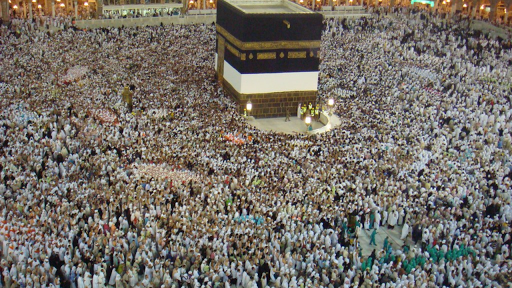
Upon arriving in Mecca, pilgrims gather in the courtyard of the Masjid al-Haram around the Kaaba. They then circumambulate—tawaf in Arabic—or walk around the Kaaba, during which they hope to kiss and touch the Black Stone—al-Hajar al-Aswad—embedded in the eastern corner of the Kaaba.
View of pilgrims performing Tawaf (circumambulating) the Kaaba from the gate of Abdul Aziz (photo: Muhammad Mahdi Karim, GNU version 1.2 only)
View of pilgrims performing Tawaf (circumambulating) the Kaaba from the gate of Abdul Aziz Image credit: photo: Muhammad Mahdi Karim, GNU version 1.2 only)

The history and form of the Kaaba

The Kaaba was a sanctuary in pre-Islamic times. Muslims believe that Abraham—known as Ibrahim in the Islamic tradition—and his son, Ismail, constructed the Kaaba. Tradition holds that it was originally a simple unroofed rectangular structure. The Quraysh tribe, who ruled Mecca, rebuilt the pre-Islamic Kaaba in c. 608 CE with alternating courses of masonry and wood. A door was raised above ground level to protect the shrine from intruders and flood waters.
Muhammad was driven out of Mecca in 620 CE to Yathrib, which is now known as Medina. Upon his return to Mecca in 629/30 CE, the shrine became the focal point for Muslim worship and pilgrimage. The pre-Islamic Kaaba housed the Black Stone and statues of pagan gods. Muhammad reportedly cleansed the Kaaba of idols upon his victorious return to Mecca, returning the shrine to the monotheism of Ibrahim. The Black Stone is believed to have been given to Ibrahim by the angel Gabriel and is revered by Muslims. Muhammad made a final pilgrimage in 632 CE, the year of his death, and thereby established the rites of pilgrimage.

Livequranforkids

We are providing the educational service of Learn quran 
online, female quran teacher,quran for kids, quran reading, 
quran memorization for kids, quran translation,online quran,  
quran for kids in USA, quran online and Online quran academy.
The journey

The journey

From the furthest reaches of the Islamic world, pilgrims have made the spiritual journey that is the ambition of a lifetime. As Hajj needs to be performed at a designated time, historically pilgrims moved together in convoys. In the past the journey could be extremely dangerous. Pilgrims often fell ill or were robbed on the way and became destitute. However, pilgrims do not fear dying on Hajj. It is believed that those who die on Hajj will go to heaven with their sins erased. Today, pilgrims can get on an airplane to reach Saudi Arabia, making the journey in contrast with the past quick and less arduous.
The Qur’an states that Hajj should take place "in the specified months," and these are the last three months of the Muslim calendar, known as Miqat Zamani (fixed times). Although the main acts of the Hajj take place in five days during the twelfth month, a pilgrim can start going into consecration (ihram) for Hajj earlier, from the beginning of the tenth month (Shawwal). The Muslim calendar is lunar, which means that the Hajj takes place progressively across all four seasons over time rather than in the full heat of summer every year. On foot, by camel, boat, train or airplane, going on Hajj is a spiritual endeavor that begins at home and culminates in Mecca; in going, arriving, and returning, the pilgrim is mindful of the magnitude of the journey and the reward in this world and the hereafter.
When pilgrims undertake the Hajj journey, they follow in the footsteps of millions before them. Nowadays hundreds of thousands of believers from over 70 nations arrive in Mecca in the Kingdom of Saudi Arabia by road, sea and air every year, completing a journey faster and in some ways less arduous than it often was in the past. Those traveling overland by camel and on foot congregated at three central points: Kufa (Iraq), Damascus (Syria) and Cairo (Egypt). Pilgrims coming by sea would enter Arabia at the port of Jedda.

Livequranforkids

We are providing the educational service of Learn quran 
online, female quran teacher,quran for kids, quran reading, 
quran memorization for kids, quran translation,online quran,  
quran for kids in USA, quran online and Online quran academy.

Mecca and the Ka'ba

Mecca and the Ka'ba

One of the five pillars of Islam central to Muslim belief, Hajj is the pilgrimage to Mecca that every Muslim must make at least once in their lifetime if they are able; it is the most spiritual event that a Muslim experiences, observing rituals in the most sacred places in the Islamic world. Mecca is the birthplace of the Prophet Muhammad. The sanctuary there with the Ka‘ba is the holiest site in Islam. As such, it is a deeply spiritual destination for Muslims all over the world; it is the heart of Islam.
At the heart of the sanctuary at Mecca lies the Ka’ba, the cube-shaped building that Muslims believe was built by Abraham and his son Ishmael. It was in Mecca that the Prophet Muhammad received the first revelations in the early 7th century. Therefore the city has long been viewed as a spiritual centre and the heart of Islam. The rituals involved with Hajj have remained unchanged since its beginning, and it continues to be a powerful religious undertaking which draws Muslims together from all over the world, irrespective of nationality or sect.
Even before Islam, Mecca was an important site of pilgrimage for the Arab tribes of north and central Arabia. Although they believed in many deities, they came once a year to worship Allah at Mecca. During this sacred month, violence was forbidden within Mecca and this allowed trade to flourish. As a result, Mecca became an important commercial centre. The revelation of Islam to the Prophet Muhammad (d. 632) restored the ancient religion of the One God to the Arab people and transformed Mecca into the holiest city in the Islamic world.

The rituals

Hajj involves a series of rituals that take place in and around Mecca over a period of five to six days. The first of these is tawaf in which pilgrims walk around the Ka‘ba seven times in an anti-clockwise direction. Muslims believe that the rituals of Hajj have their origin in the time of the prophet Ibrahim (Abraham). Muhammad led the Hajj himself in 632, the year of his death. The Hajj now attracts about three million pilgrims every year from across the world.

Livequranforkids

We are providing the educational service of Learn quran 
online, female quran teacher,quran for kids, quran reading, 
quran memorization for kids, quran translation,online quran,  
quran for kids in USA, quran online and Online quran academy.

Pilgrimage to Mecca—Hajj

1. The Profession of Faith—The Shahada

The Profession of Faith, the shahada, is the most fundamental expression of Islamic beliefs. It simply states that “There is no God but God and Muhammad is his prophet.” It underscores the monotheistic nature of Islam. It is an extremely popular phrase in Arabic calligraphy and appears in numerous manuscripts and religious buildings.

2. Daily Prayers—Salat

Muslims are expected to pray five times a day. This does not mean that they need to attend a mosque to pray; rather, the salat, or the daily prayer, should be recited five times a day. Muslims can pray anywhere; however, they are meant to pray towards Mecca. The faithful pray by bowing several times while standing and then kneeling and touching the ground or prayer mat with their foreheads, as a symbol of their reverence and submission to Allah. On Friday, many Muslims attend a mosque near midday to pray and to listen to a sermon, khutba.

3. Alms-Giving—Zakat

The giving of alms is the third pillar. Although not defined in the Qu’ran, Muslims believe that they are meant to share their wealth with those less fortunate in their community of believers.

4. Fasting during Ramadan—Saum

During the holy month of Ramadan, the ninth month in the Islamic calendar, Muslims are expected to fast from dawn to dusk. While there are exceptions made for the sick, elderly, and pregnant, all are expected to refrain from eating and drinking during daylight hours.
Hundreds throng around the Kaaba at the start of Hajj (photo: Al Jazeera English, CC BY-SA 2.0)

5. Pilgrimage to Mecca—Hajj

All Muslims who are able are required to make the pilgrimage to Mecca and the surrounding holy sites at least once in their lives. Pilgrimage focuses on visiting the Kaaba and walking around it seven times. Pilgrimage occurs in the 12th month of the Islamic Calendar.

Livequranforkids

We are providing the educational service of Learn quran 
online, female quran teacher,quran for kids, quran reading, 
quran memorization for kids, quran translation,online quran,  
quran for kids in USA, quran online and Online quran academy.