Tuesday, June 16, 2020

THE QUR’AN AS RECITATION

THE QUR’AN AS RECITATION

The Qur’an for Muslims is a source of divine blessing and merit, tranquillity and guidance. With it, a child is greeted at birth, by it he or she is guided through life’s journey, and with it, sent to the final abode. This long journey through life with the Qur’an is to include a recitation of the entire Qur’an over a specific period or a week, a month, or longer in accordance with divisions of the sacred text for daily recitation. This process is known as Khatm al-Qur’an or completion of its recitation. On special occasions, such as the fasting month of Ramadan, the pious undertake to recite the entire Qur’an by dividing it up into thirty equal parts that correspond with the thirty nights of the Muslim sacred month. Prophet Muhammad is said to have called such a person who journeys through the Qur’an "the sojourning traveller". This is because when the reciter comes to the end of his or her recitation, he or she must start over at the beginning again.

Muslims find the recitation, memorising, copying or possessing a copy of the Qur’an in their homes a source of great blessing. Indeed, it is believed that on the day of resurrection, the status of a Muslim man or woman in paradise will be determined by the number of verses of the Qur’an that he or she has memorised during their earthly life. An even greater source of merit and blessing for Muslims is found in studying and understanding the principles and precepts of the Qur’an. The Prophet is said to have declared: There are no people assembled in one of the houses of God to recite the Book of God and study it together but that the sakinah (divine tranquillity) descends upon them. The term sakinah is possibly derived from the Hebrew term sheckinah, which means "to the glory of Jehovah." Such a derivation may have been the result of contact Prophet Muhammad had with both Jews and Christians prior to and during his revelations. "Mercy covers them, angels draw near to them, and God remembers them in the company of those who are with him." The reciters of the Qur’an, those who memorise its words and live by its precepts, are said to be heirs to the Prophet. The Qur’an is believed to sanctify the heart and home of the Muslim and make him or her a partaker of Divine revelation. Its word inscribed on a building, a business, or vehicle is believed to invoke a blessing or protection.

Livequranforkids


We are providing the educational service of Learn quran 

online, female quran teacher,quran for kids, quran reading, 

quran memorization for kids, quran translation,online quran,  

quran for kids in USA, quran online and Online quran academy.


Arrangement of the Qur’an

Arrangement of the Qur’an

The Qur’an was subsequently written down and memorised by professing Muslim men and women. Yet, when the Prophet died in 632 CE, ten years after the Hijra, that is, his migration from Mecca to Medina, the Qur’an as it is known today, did not exist. The verses and chapters, or suraswere at that time scattered fragments of the writings of Prophet Muhammad’s scribes, preserved on privately collected pieces of parchment, stone, palm leaf, and leather, in addition to words preserved in human memory. It was during the reign of the third Muslim caliph (or religious leader) Uthman, who governed the existing Muslim community several generations after Prophet Muhammad’s death, that the Qur’an was given its standard form, which remains unchanged to this day. The suras were arranged so that, generally, there would be progression from the longest chapter to the shortest. It is that arrangement that has been preserved as the authoritative version of the Qur’an.

It is essential for every pious Muslim to memorise as much of the Qur’an as possible. A Muslim prayer in the solitude of a room or in a congregation begins with the words of the Qur’an’s opening sura (Al-Fatihah). Prayer is considered to be a way for Muslims to appropriate the word of Allah. This divine-human interchange is eloquently expressed in a hadith qudsi, a saying of the Prophet quoting God:

I have divided the prayer (salat) between me and my servant, and my servant shall have whatever he prays for. For when the servant says: ‘All praise be to God, the Lord of all beings,’ God says: ‘My servant has praised me’. When the servant says: ‘The All-Merciful, the Compassionate,’ God says: ‘My servant has glorified me ... this is my portion and to him belongs what remains’. (M. Ayoub, The Qur’an and Its Interpreters).

The Fatihah, the opening sura of the Qur’an, is considered by Muslims to be the perfect prayer. The first three and one-half of its seven verses is a prayer of praise. The rest of the sura is a prayer for divine guidance and grace. Not only the Fatiha but the entire Qur’an is a Muslim prayer. It is also a divine address to Muslims. Thus, in every prayer, God is believed to reveal Himself and the Muslim believer is to receive the word of God. Muslim prayer is the human connection to God through the Qur’an.


Livequranforkids


We are providing the educational service of Learn quran 

online, female quran teacher,quran for kids, quran reading, 

quran memorization for kids, quran translation,online quran,  

quran for kids in USA, quran online and Online quran academy.

Prophet Muhammad’s questions about the meaning of human life

Muslims also believe that the Qur’an was also sent down in part, to Prophet Muhammad’s heart on the "night of determination" (Qur’an 44:3 and 97:1), a blessed night for all Muslims. This event sanctified his life and made Prophet Muhammad an example for Muslims to follow. In the Qur’an, God asked: Am I not your Lord? and those who chose to worship God affirmed as Lord responded with the words: Yes, we bear witness... (Qur’an 7: 172). The Qur’an is the seal and testimony to this covenant. Its message is, for Muslims, a powerful affirmation of divine lordship and Muslim commitment.

The Qur’an as an earthly text has been inextricably bound to Muslim history. It served as an answer to the problems of the Arab society in Prophet Muhammad’s time. The Qur’an was also a response to Prophet Muhammad’s questions about the meaning of human life and the mystery of creation, and was closely linked to the history of the nascent Muslim community in Mecca and, later, in Medina. Many of the Qur’anic verses are said to have been revealed in answer to specific questions or life situations. The answers given are seen by Muslims to be general principles, moral imperatives, or precepts applicable to all times and places. The family of the Prophet, which the Qur’an directly addressed (see Qur’an 33:32), is seen by Muslims to be a model for all families and all societies in the world.

Livequranforkids


We are providing the educational service of Learn quran 

online, female quran teacher,quran for kids, quran reading, 

quran memorization for kids, quran translation,online quran,  

quran for kids in USA, quran online and Online quran academy.

pious Muslim hears God’s voice guiding

In the Qur’an, a pious Muslim hears God’s voice guiding and encouraging, consoling and reproaching, promising the righteous mercy and eternal bliss, while threatening the wicked with wrath and eternal torment. For Muslims, the Qur’an is the word of God, which has entered human time to shape history. According to Muslim sources, the Angel Gabriel revealed himself to Prophet Muhammad in 610 CE while he was in prayerful retreat in a cave on Mount Hira, outside Mecca. It is said that in this initial meeting, the Angel Gabriel pressed Muhammad so vehemently that he felt he was being choked. The Qur’an states that the angel then commanded:

Recite in the name of your Lord who created, created man from a blood clot. Recite, for your Lord is most magnanimous - who taught by the pen; taught man that which he did not know. (Qur’an 96:1-5)

Muslims claim that God warned Prophet Muhammad: We shall surely lay upon you weighty speech, and enjoined him to rise up through most of the night in prayer, and remember fervently what he was told to be, "the Lord of the east and the west" (Qur’an 73:5 and 73:8). For Muslims this "weighty speech" marked Prophet Muhammad as the last Messenger of God to humankind; this event was to have a great impact on the course of human history.

The Qur’an is said to have been communicated to Prophet Muhammad in two ways. Muslims believe that it was communicated through the Angel Gabriel. These communications were revealed in small portions: single verses, groups of verses, and entire chapters or suras over a period of twenty to twenty-two years. The Qur’an for Muslims is not only words that can be uttered, heard, and recorded; it is also the heavenly archetype of which the recited and written Qur’an is only an earthly copy. The Qur’an in its heavenly archetypal form is for Muslims the source of divine revelation throughout human history and is eternally preserved by God. It is the covenant of God with humankind which He established with the children of Adam when they were but ideas or essences in the divine realm. Prophet Muhammad also professed to have experienced this heavenly Qur’an, in addition to having been the recipient of revelation. He would experience a profound spiritual state, shivering on a hot summer day or sweating on a cold winter day, hearing sounds like the ringing of a bell. These sounds transformed themselves in his consciousness into human words, which he memorised and had recorded.

Livequranforkids


We are providing the educational service of Learn quran 

online, female quran teacher,quran for kids, quran reading, 

quran memorization for kids, quran translation,online quran,  

quran for kids in USA, quran online and Online quran academy.

Friday, May 29, 2020

decorative elements common to most mosques

Furnishings

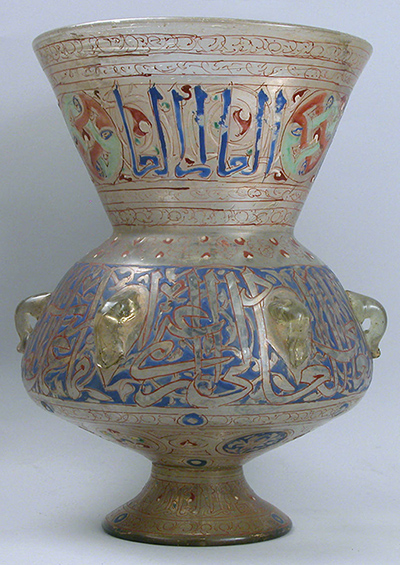
Mosque lamp, 14th century, Egypt or Syria, blown glass, enamel, gilding, 31.8 x 23.2 cm (Metropolitan Museum of Art)
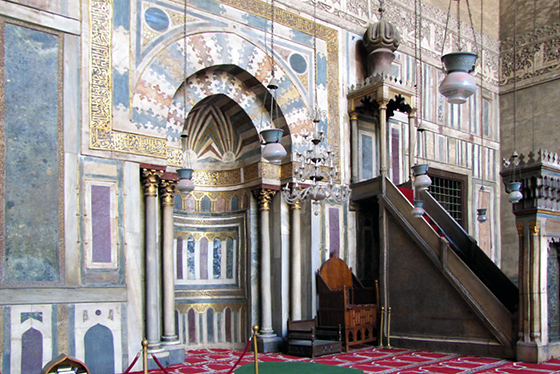
There are other decorative elements common to most mosques. For instance, a large calligraphic frieze or a cartouche with a prominent inscription often appears above the mihrab. In most cases the calligraphic inscriptions are quotations from the Qur’an, and often include the date of the building's dedication and the name of the patron. Another important feature of mosque decoration are hanging lamps, also visible in the photograph of the Sultan Hasan mosque. Light is an essential feature for mosques, since the first and last daily prayers occur before the sun rises and after the sun sets. Before electricity, mosques were illuminated with oil lamps. Hundreds of such lamps hung inside a mosque would create a glittering spectacle, with soft light emanating from each, highlighting the calligraphy and other decorations on the lamps’ surfaces. Although not a permanent part of a mosque building, lamps, along with other furnishings like carpets, formed a significant—though ephemeral—aspect of mosque architecture.

Mosque patronage

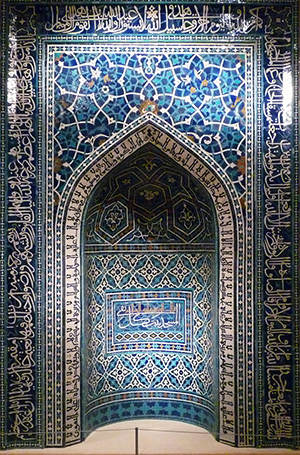
Mihrab, 1354–55, just after the Ilkhanid period, Madrasa Imami, Isfahan, Iran, polychrome glazed tiles, 343.1 x 288.7 cm (Metropolitan Museum of Art)
Most historical mosques are not stand-alone buildings. Many incorporated charitable institutions like soup kitchens, hospitals, and schools. Some mosque patrons also chose to include their own mausoleum as part of their mosque complex. The endowment of charitable institutions is an important aspect of Islamic culture, due in part to the third pillar of Islam, which calls for Muslims to donate a portion of their income to the poor.
The commissioning of a mosque would be seen as a pious act on the part of a ruler or other wealthy patron, and the names of patrons are usually included in the calligraphic decoration of mosques. Such inscriptions also often praise the piety and generosity of the patron. For instance, the mihrab now at the Metropolitan Museum of Art, bears the inscription:
And he [the Prophet], blessings and peace be upon him, said: “Whoever builds a mosque for God, even the size of a sand-grouse nest, based on piety, [God will build for him a palace in Paradise].”
The patronage of mosques was not only a charitable act therefore, but also, like architectural patronage in all cultures, an opportunity for self-promotion. The social services attached the mosques of the Ottoman sultans are some of the most extensive of their type. In Ottoman Turkey the complex surrounding a mosque is called a kulliye. The kulliye of the Mosque of Sultan Suleyman, in Istanbul, is a fine example of this phenomenon, comprising a soup kitchen, a hospital, several schools, public baths, and a caravanserai (similar to a hostel for travelers). The complex also includes two mausoleums for Sultan Suleyman and his family members.

Livequranforkids

We are providing the educational service of Learn quran 
online, female quran teacher,quran for kids, quran reading, 
quran memorization for kids, quran translation,online quran,  
quran for kids in USA, quran online and Online quran academy.

mosque architecture is the minaret

Minaret (tower)

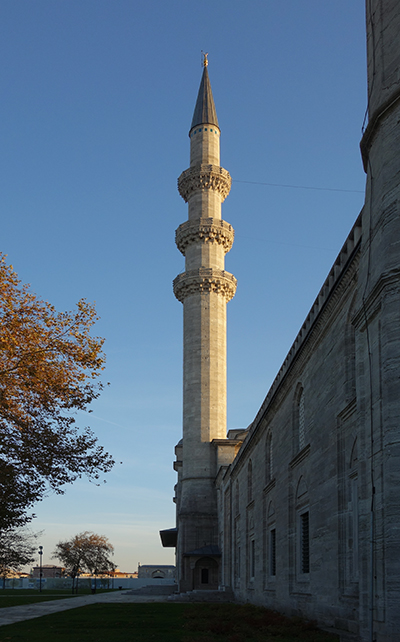
One of the most visible aspects of mosque architecture is the minaret, a tower adjacent or attached to a mosque, from which the call to prayer is announced.
Mimar Sinan, Minaret, Süleymaniye Mosque, Istanbul, 1558
Minarets take many different forms—from the famous spiral minaret of Samarra, to the tall, pencil minarets of Ottoman Turkey. Not solely functional in nature, the minaret serves as a powerful visual reminder of the presence of Islam.

Qubba (dome)

Most mosques also feature one or more domes, called qubba in Arabic. While not a ritual requirement like the mihrab, a dome does possess significance within the mosque—as a symbolic representation of the vault of heaven. The interior decoration of a dome often emphasizes this symbolism, using intricate geometric, stellate, or vegetal motifs to create breathtaking patterns meant to awe and inspire. Some mosque types incorporate multiple domes into their architecture (as in the Ottoman Süleymaniye Mosque pictured at the top of the page), while others only feature one. In mosques with only a single dome, it is invariably found surmounting the qibla wall, the holiest section of the mosque. The Great Mosque of Kairouan, in Tunisia (not pictured) has three domes: one atop the minaret, one above the entrance to the prayer hall, and one above the qibla wall.
Because it is the directional focus of prayer, the qibla wall, with its mihrab and minbar, is often the most ornately decorated area of a mosque. The rich decoration of the qibla wall is apparent in this image of the mihrab and minbar of the Mosque of Sultan Hasan in Cairo, Egypt (see image higher on the page).

Livequranforkids

We are providing the educational service of Learn quran 
online, female quran teacher,quran for kids, quran reading, 
quran memorization for kids, quran translation,online quran,  
quran for kids in USA, quran online and Online quran academy.
Sahn (courtyard)

Sahn (courtyard)

The most fundamental necessity of congregational mosque architecture is that it be able to hold the entire male population of a city or town (women are welcome to attend Friday prayers, but not required to do so). To that end congregational mosques must have a large prayer hall. In many mosques this is adjoined to an open courtyard, called a sahn. Within the courtyard one often finds a fountain, its waters both a welcome respite in hot lands, and important for the ablutions (ritual cleansing) done before prayer.
Mihrab & minbar, Mosque of Sultan Hassan, Cairo, 1356-63 (photo: Dave Berkowitz, CC BY 2.0)

Mihrab (niche)

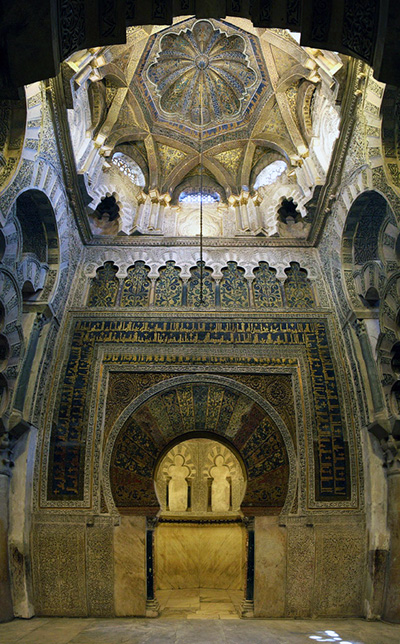
Mihrab, Great Mosque of Cordoba, c. 786 (photo: Bongo Vongo, CC BY-SA 2.0)
Another essential element of a mosque’s architecture is a mihrab—a niche in the wall that indicates the direction of Mecca, towards which all Muslims pray. Mecca is the city in which the Prophet Muhammad was born, and the home of the most important Islamic site, the Kaaba. The direction of Mecca is called the qibla, and so the wall in which the mihrab is set is called the qibla wall. No matter where a mosque is, its mihrab indicates the direction of Mecca (or as near that direction as science and geography were able to place it). Therefore, a mihrab in India will be to the west, while a one in Egypt will be to the east. A mihrab is usually a relatively shallow niche, as in the example from Egypt, above. In the example from Spain, shown left, the mihrab’s niche takes the form of a small room, this is more rare.

Livequranforkids

We are providing the educational service of Learn quran 
online, female quran teacher,quran for kids, quran reading, 
quran memorization for kids, quran translation,online quran,  
quran for kids in USA, quran online and Online quran academy.